
Jewelry Education
Are Common Jewelry Myths True? Jewelry Myths Debunked by Hopman Jewelers in Down
Published: May 18, 2026
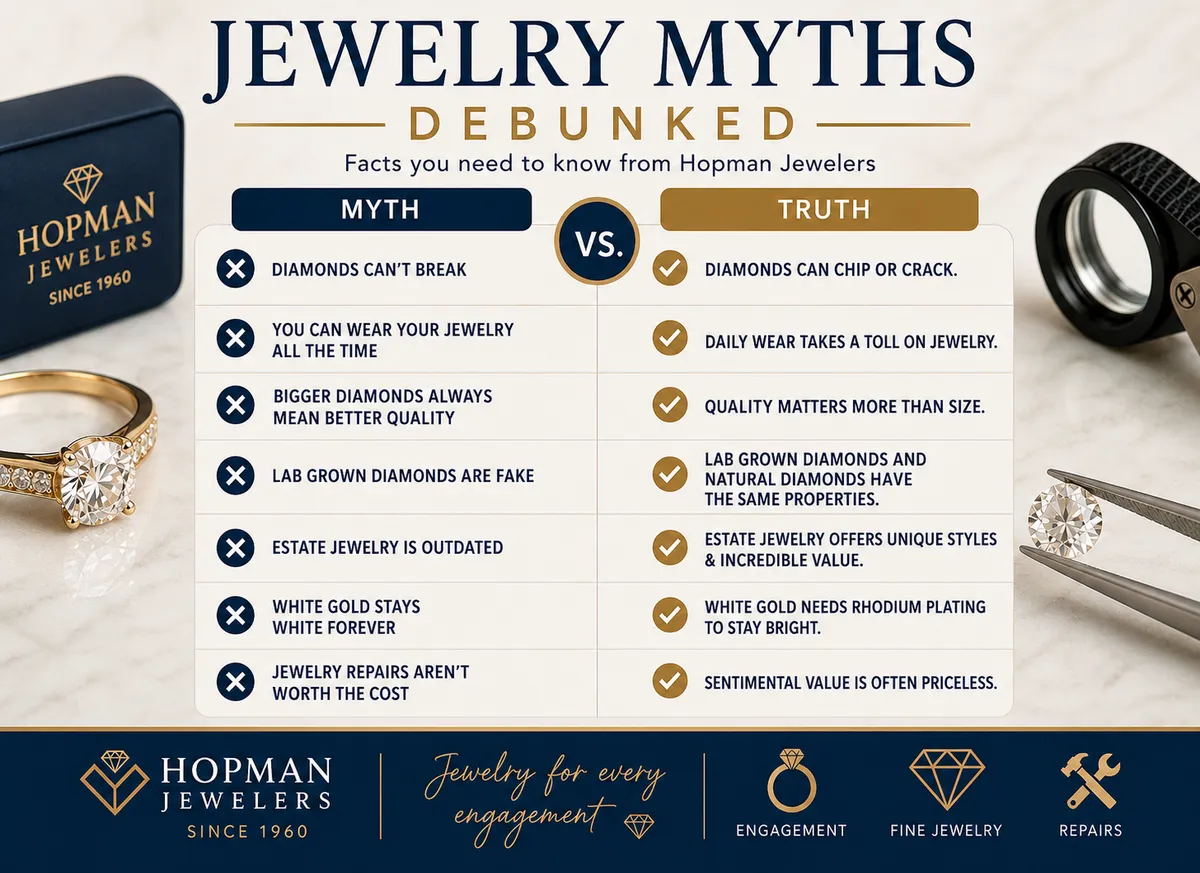
Are Common Jewelry Myths True? Jewelry Myths Debunked by Hopman Jewelers in Downtown Elkhart
Table of Contents
- Quick Answer: Are Jewelry Myths True?
- Myth #1: Diamonds Are Indestructible
- Myth #2: You Can Wear Every Jewelry Piece All the Time
- Myth #3: Bigger Diamonds Always Mean Better Quality
- Myth #4: Lab Grown Diamonds Are Fake
- Myth #5: Estate Jewelry Is Outdated
- Myth #6: White Gold Stays White Forever
- Myth #7: Jewelry Repairs Aren't Worth the Cost
- Why Professional Jewelry Care Matters
- Visit Hopman Jewelers in Downtown Elkhart
- FAQ
Quick Answer: Are Jewelry Myths True?
Many jewelry myths have been passed down for generations. Some started from old advice, while others came from misunderstandings about gemstones, metals, and jewelry care. The truth is that proper information can help you protect your jewelry, make smarter buying decisions, and enjoy your favorite pieces for years.At Hopman Jewelers in Downtown Elkhart, we hear these questions every day. Let's separate fact from fiction.
Myth #1: Diamonds Are Indestructible
Diamonds are incredibly durable, but they are not indestructible.Diamonds rank a 10 on the Mohs hardness scale, which measures a material's resistance to scratching. Because diamonds are the hardest natural material, most everyday objects cannot scratch them. However, diamonds can scratch other diamonds.
It is also important to understand that hardness and toughness are not the same thing. Hardness means resistance to scratches. Toughness refers to how well a gemstone resists breaking or chipping.
Diamonds can still:
- Chip along edges or points
- Crack from a hard impact
- Break along natural cleavage lines
- Become more vulnerable if they contain large or numerous inclusions
Truth:
Diamonds are absolutely strong enough for everyday wear, which is one reason they remain the most popular choice for engagement rings. However, they should still be treated with care.To help protect your jewelry:
✔ Remove rings before cleaning with chemicals
✔ Remove jewelry before exercising or lifting weights
✔ Avoid wearing jewelry during heavy activities or yard work
✔ Store diamond jewelry separately to prevent diamonds from scratching one another
✔ Have your jewelry professionally inspected at least once a year
Regular inspections allow a jeweler to check prongs, settings, and the overall condition of your piece before small issues become larger problems.
A diamond may last forever, but proper care helps keep it looking beautiful for generations.
Myth #2: You Can Wear Every Jewelry Piece All the Time
Many people never remove their jewelry. Wedding rings especially can become part of a daily routine, and after a while, people forget they are even wearing them. However, even if your gemstones are durable, the jewelry itself experiences wear over time.Daily activities can put stress on:
- Prongs
- Ring shanks
- Chains
- Clasps
- Gemstone settings
- Finishes and plating
- Swimming - Chlorine can weaken certain metals over time
- Gardening – Can scratch metals
- Cleaning products – Can weaken metals & dull gemstones
- Sleeping – Can kink or stretch them
- Working out & lifting weights– Can bend rings out of shape
- Applying lotions, perfumes, or hairspray - Lotions and soaps create buildup behind gemstones
Truth:
Fine jewelry is made to be enjoyed every day, but it still deserves care and maintenance.To help your jewelry last:
✔ Remove jewelry before exercising or lifting weights
✔ Remove jewelry while cleaning with chemicals
✔ Take rings off during heavy work or outdoor activities
✔ Put jewelry on after lotions, perfumes, and hairspray
✔ Have jewelry professionally cleaned and inspected every year
Regular inspections can identify worn prongs, thinning metal, loose settings, and other issues before they become larger repairs.
Myth #3: Bigger Diamonds Always Mean Better Quality
Carat weight often gets the most attention because it is the easiest thing to see, but size is only one part of a diamond's beauty and quality.A diamond’s overall appearance depends on the balance of the 4Cs:
- Cut
- Color
- Clarity
- Carat Weight
For example:
You could have:
A 3.00ct I2 clarity diamond with visible inclusions, dark characteristics, and reduced brilliance
Or:
A 1.00ct VVS1 clarity diamond with exceptional clarity, excellent light return, and beautiful sparkle
A larger stone with noticeable inclusions may appear dull or cloudy, while a smaller diamond with higher quality characteristics can appear brighter and more eye-catching.
The cut of a diamond also plays a major role. Poor proportions can cause light to leak out of the bottom of the stone instead of reflecting back to your eye.
Truth:
Bigger does not always mean better. The most beautiful diamonds usually come from the right balance of:✔ Strong cut quality
✔ Attractive color
✔ Good clarity
✔ Appropriate carat size
A well-balanced diamond can often appear more beautiful than a larger diamond with visible inclusions or poor proportions.
Myth #4: Lab Grown Diamonds Are Fake
This topic creates a lot of confusion.Lab-grown diamonds and natural diamonds have the same:
- Chemical composition
- Optical properties
- Physical properties
Natural diamonds formed within the earth over billions of years through heat and pressure.
Lab-grown diamonds are created in controlled environments using advanced technology that replicates those natural conditions.
Lab-grown diamonds should not be confused with simulants such as:
- Cubic zirconia
- Moissanite
- Crystal substitutes
Truth:
Natural and lab-grown diamonds often appeal to different buyers.Many customers choose lab-grown diamonds because they can purchase:
✔ Larger sizes
✔ Higher clarity grades
✔ More diamond for the same budget
Many customers choose natural diamonds because they value:
✔ Rarity
✔ Natural origin
✔ Long-term desirability
✔ Traditional appeal
Neither choice is automatically right or wrong. The best choice depends on what matters most to the customer.
Myth #5: Estate Jewelry Is Outdated
Some people hear the word "estate" and picture old jewelry hidden away in a drawer. Today's estate market is much different.Estate jewelry can include:
- Vintage engagement rings
- Designer jewelry
- Luxury brands
- Classic yellow gold pieces
- Modern styles
- One-of-a-kind gemstone jewelry
Truth:
Estate jewelry often gives customers something they cannot easily find in new production jewelry:✔ Unique designs
✔ Handcrafted details
✔ Exceptional value
✔ Vintage character
✔ One-of-a-kind pieces
Sometimes older jewelry also contains craftsmanship techniques that are less common today.
Myth #6: White Gold Stays White Forever
Many customers are surprised when their white gold ring begins looking slightly warmer or more yellow over time. White gold is not naturally bright white. White gold is created by mixing yellow gold with white alloys, then applying rhodium plating to give it that bright white appearance.Daily wear and your bodies acidity levels slowly affect the finish.
Things that speed wear include:
- Hand washing
- Cleaning chemicals
- Lotions
- Exercise
- Daily friction
Truth:
White gold maintenance is completely normal. Rhodium plating simply refreshes the appearance of your jewelry.Think of it like:
✔ Maintaining a vehicle
✔ Cleaning leather shoes
✔ Polishing silver
Regular maintenance helps jewelry continue looking its best.
Myth #7: Jewelry Repairs Aren't Worth the Cost
We hear this often: "The repair costs more than the piece is worth." But value is not always determined by the cost of gold or diamonds.Jewelry frequently represents:
- Family history
- Milestones
- Engagements
- Military memories
- Loved ones
- Generational keepsakes
Truth:
The value of jewelry is often much larger than the materials themselves. Some of the most meaningful pieces we see in our store would never sell for thousands of dollars, but to the person wearing them, they are priceless.Why Professional Jewelry Care Matters
Regular inspections help prevent small issues from becoming larger and more costly repairs. Many jewelry problems begin with wear that isn't visible to the eye, which is why routine maintenance is so important.At Hopman Jewelers we recommend having your jewelry professionally cleaned and inspected at least once a year to help keep it looking beautiful and functioning properly.
During an inspection, we can check for:
✔ Worn prongs
✔ Loose stone
✔ Cracking or damaged areas of metal
✔ Ring and setting inspections
✔ Clasp and chain wear
Small issues caught early often become simple repairs instead of major restorations. A routine inspection today can help protect the pieces you'll wear and treasure for years to come.
Visit Hopman Jewelers in Downtown Elkhart
Whether you need a repair, are shopping for estate jewelry, exploring lab grown diamonds, or simply have questions, our team is here to help.
Since 1960, Hopman Jewelers has helped families celebrate life's biggest moments.
Jewelry for every engagement
Frequently Asked Questions
Can diamonds crack or break?Yes. Diamonds are the hardest natural material and resist scratching from most everyday objects, but hardness does not mean they are indestructible. Diamonds can chip or crack from hard impacts, and stones with large or numerous inclusions may be more vulnerable to damage.
Is estate jewelry just used jewelry?
Estate jewelry simply means previously owned jewelry. Many estate pieces are vintage, designer, one-of-a-kind, or feature craftsmanship and styles that may be difficult to find in modern collections.
How often should jewelry be cleaned and inspected?
We recommend having your jewelry professionally cleaned and inspected at least once a year. Routine inspections help identify worn prongs, loose stones, thinning metal, and other issues before they become larger repairs.
Are lab-grown diamonds the same as natural diamonds?
Lab-grown diamonds and natural diamonds have the same chemical, optical, and physical properties. The main difference is how they are formed. Natural diamonds develop within the earth over billions of years, while lab-grown diamonds are created using advanced technology in controlled environments.
How often should white gold be rhodium plated?
Rhodium plating varies depending on lifestyle and wear. Many customers choose to refresh their white gold every 1–3 years, although rings worn daily may need it more frequently.