
What Are the 4Cs of Diamonds, and Why Do They Matter?
Table of Contents
- What Are the 4Cs of Diamonds?
- What Is Diamond Cut?
- What Is Diamond Color?
- What Is Diamond Clarity?
- What Is Diamond Carat Weight?
- Which of the 4Cs Is Most Important?
- How Do the 4Cs Affect Diamond Prices?
- How to Choose the Right Diamond for Your Budget
- Why Buy Your Diamond from Hopman Jewelers?
- Frequently Asked Questions
Summary
The 4Cs of diamonds, Cut, Color, Clarity, and Carat Weight, are the four primary characteristics used to evaluate a diamond's quality. Developed by the Gemological Institute of America (GIA), this internationally recognized system helps consumers understand why diamonds differ in appearance, rarity, and value.Whether you're shopping for an engagement ring, diamond stud earrings, a pendant, or a special anniversary gift, understanding the 4Cs can help you make a more informed purchase.
At Hopman Jewelers in downtown Elkhart, Indiana, we believe purchasing a diamond should be an exciting experience, not an overwhelming one. Learning a few diamond basics can help you find a beautiful diamond that fits your personal style and budget.
What Are the 4Cs of Diamonds?
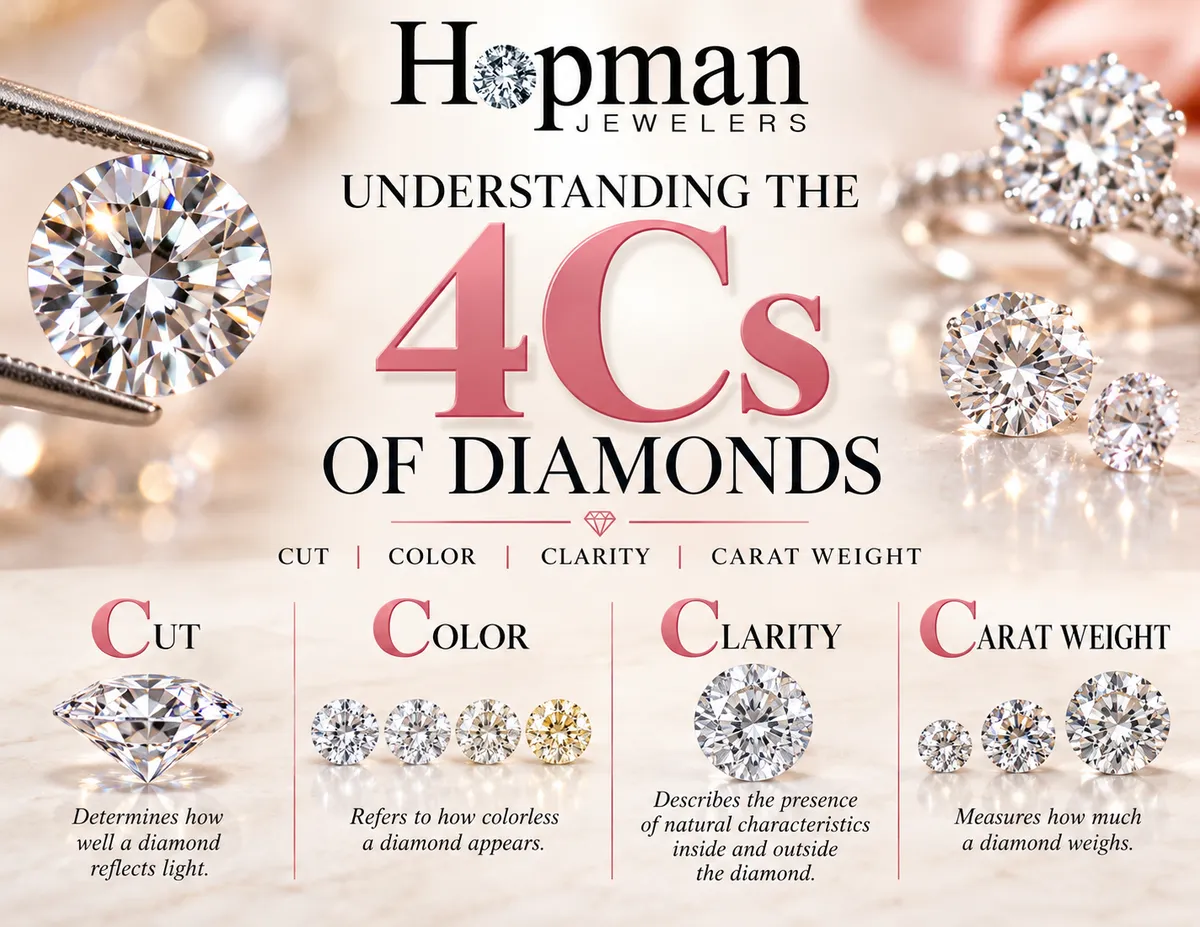
The 4Cs provide a consistent way to evaluate and compare diamonds. Each characteristic contributes to a diamond's overall beauty, quality, and value.The four characteristics are:
- Cut: How well a diamond has been proportioned and polished to reflect light.
- Color: How colorless a diamond appears on the traditional D-to-Z grading scale.
- Clarity: The presence or absence of internal characteristics and external blemishes.
- Carat Weight: How much a diamond weighs.
Understanding the 4Cs allows you to compare diamonds beyond their size or price tag.
Discover all the details about the 4Cs.
What Is Diamond Cut?
Of the four characteristics, cut is often considered one of the most important factors affecting a diamond's visual beauty.A diamond's cut describes how well its facets, proportions, and finish work together to interact with light.
A beautifully cut diamond can display exceptional brilliance and sparkle, while a poorly proportioned diamond may appear less lively, even if it has excellent color and clarity.
What Makes a Diamond Sparkle?
Three important visual characteristics contribute to a diamond's appearance:- Brightness: The white light reflected from the diamond.
- Fire: The colorful flashes created when white light separates into spectral colors.
- Scintillation: The sparkle and contrasting patterns of light and dark that appear as the diamond moves.
Diamond Cut Grades
GIA evaluates the cut quality of standard round brilliant diamonds using five grades:Cut Grade Description
Excellent Exceptional overall cut quality
Very Good High-quality cut with attractive light performance
Good Good overall appearance
Fair Less desirable light performance
Poor Noticeable limitations in light performance
An important distinction is that diamond cut and diamond shape are not the same thing.
Shape refers to whether a diamond is round, oval, pear, princess, emerald, or another outline. Cut quality describes the craftsmanship and proportions of the finished diamond.
GIA's traditional overall cut grading scale applies to standard round brilliant diamonds, rather than every fancy-shaped diamond.
Shopping tip: If sparkle is your priority, pay close attention to cut quality rather than choosing a diamond based on carat weight alone.
What Is Diamond Color?
When discussing traditional white diamonds, color refers to how little body color a diamond displays.GIA grades diamonds on a scale beginning with D, which represents colorless, and continuing through Z, where light yellow or brown color becomes more noticeable.
Understanding the Diamond Color Scale
Color Grade ClassificationD–F Colorless
G–J Near Colorless
K–M Faint Color
N–R Very Light Color
S–Z Light Color
Many diamonds in the near-colorless range can appear beautifully white when viewed face-up, especially once mounted in jewelry.
Does Diamond Color Matter?
Color preferences can depend on the type of jewelry and the metal used in the setting.For example, a diamond with a slightly warmer color may complement a yellow gold setting beautifully.
Meanwhile, someone choosing a platinum or white gold engagement ring may prefer a diamond with a higher color grade.
The goal isn't necessarily to purchase the highest color grade. It's to find a diamond whose appearance you love.
Shopping tip: Compare diamonds side by side whenever possible. Small differences in color grades are not always easy to distinguish without controlled grading conditions.
What Is Diamond Clarity?
Natural diamonds form under extraordinary geological conditions deep within the Earth. During their formation, they may develop internal characteristics called inclusions.Diamonds may also have external characteristics known as blemishes.
Clarity refers to the number, size, location, nature, and visibility of these characteristics.
Understanding the Diamond Clarity Scale
Clarity Grade MeaningFL Flawless
IF Internally Flawless
VVS1–VVS2 Very, Very Slightly Included
VS1–VS2 Very Slightly Included
SI1–SI2 Slightly Included
I1–I3 Included
Professional diamond clarity grading generally takes place under 10× magnification.
Does a Diamond Need to Be Flawless?
Absolutely not.Many diamonds contain inclusions that are difficult or impossible to see without magnification.
A diamond with a VS or SI clarity grade may still be beautiful, depending on the type and location of its inclusions.
In some cases, inclusions may be more noticeable in certain diamond shapes, particularly step-cut styles such as emerald cuts.
Other inclusions may affect durability, making it important to evaluate more than the clarity grade alone.
Shopping tip: Ask to see a diamond under magnification and with your unaided eye. Understanding where its inclusions are located can help you determine whether they affect its appearance.
What Is Diamond Carat Weight?
Carat weight measures how much a diamond weighs, not its actual dimensions.One metric carat equals 200 milligrams and is divided into 100 points.
For example:
- 0.25 carat = 25 points
- 0.50 carat = 50 points
- 0.75 carat = 75 points
- 1.00 carat = 100 points
- 2.00 carats = 200 points
Does a Larger Carat Weight Mean a Better Diamond?
Not necessarily.Two diamonds weighing exactly one carat may look different in size because of their proportions and shape.
They may also differ significantly in brilliance, color, clarity, and price.
A smaller diamond with excellent cut quality may appear more brilliant than a larger diamond with poor proportions.
What Is Total Carat Weight?
When shopping for diamond jewelry, you may see the abbreviation CTW, which means carat total weight.This describes the combined weight of multiple diamonds in a piece of jewelry.
For example, a pair of diamond stud earrings advertised as 1.00 CTW typically contains two diamonds weighing approximately 0.50 carat each.
Understanding this distinction is especially important when comparing earrings, tennis bracelets, and multi-stone rings.
Shopping tip: Consider how a diamond looks on the hand, neck, or ears rather than focusing only on the carat weight.
Which of the 4Cs Is Most Important?
There isn't one answer that works for everyone.However, cut quality is often an excellent place to begin because it has such a significant influence on a diamond's brilliance.
From there, your personal preferences and budget can help determine how to prioritize color, clarity, and carat weight.
For example:
If sparkle matters most: Consider prioritizing excellent cut quality.
If size matters most: You may prefer a slightly larger diamond with a lower color or clarity grade that still looks beautiful.
If a bright white appearance matters most: Consider comparing diamonds in the colorless and near-colorless ranges.
If rarity matters most: Higher color and clarity grades may appeal to you.
The most important consideration is finding a diamond that balances beauty, quality, and price in a way that feels right for you.
How Do the 4Cs Affect Diamond Prices?
Diamond prices depend on the combination of all four characteristics.Generally, diamonds become more valuable as desirable characteristics become rarer.
However, price differences aren't always gradual.
For example, a diamond weighing 1.00 carat may cost noticeably more than a diamond weighing 0.90 or 0.95 carat with otherwise similar characteristics.
This is partly because certain carat weights are especially popular.
Similarly, moving from one clarity or color grade to another may affect the price even when the visual difference is difficult to detect.
Other considerations, including shape, grading documentation, market conditions, and whether the diamond is natural or laboratory-grown, also influence pricing.
Remember: The most expensive diamond isn't automatically the best choice for every customer.
How to Choose the Right Diamond for Your Budget
Shopping for a diamond doesn't have to be complicated.Here are five practical steps to help you get started.
1. Determine Your Comfortable Budget
Decide what you'd like to spend before comparing diamonds.There is no universal rule that determines how much you should spend on an engagement ring or diamond gift.
Choose an amount that makes sense for your circumstances.
2. Decide Which Characteristics Matter Most
Think about whether you value sparkle, size, color, rarity, or a combination of these qualities.Your priorities will help narrow the selection.
3. Compare Diamonds in Person
Photographs and grading reports provide helpful information, but they cannot fully replace seeing a diamond.Examine different diamonds under several lighting conditions whenever possible.
4. Ask About Diamond Grading Reports
Independent diamond grading reports can provide important information about a diamond's characteristics.For natural diamonds, GIA grading reports are widely recognized throughout the jewelry industry.
A grading report documents diamond quality; it is not the same as a monetary appraisal.
5. Work With a Knowledgeable Jeweler
A knowledgeable jeweler can explain the differences between diamonds and help you understand how the 4Cs relate to your budget.They can also help you consider the setting, metal, jewelry style, and long-term maintenance of your purchase.
Learn more about buying a diamond.
Why Buy Your Diamond from Hopman Jewelers?
Since 1960, Hopman Jewelers has proudly served Elkhart and the surrounding communities.Located in beautiful downtown Elkhart, our store offers a wide selection of fine jewelry, including natural diamonds, lab-grown diamonds, engagement rings, wedding bands, diamond earrings, pendants, and more.
We believe that choosing a diamond should be a personal experience.
Whether you're planning a proposal, celebrating an anniversary, or beginning your Christmas shopping, our team can help you explore different styles and understand the qualities that make each diamond unique.
We also offer custom jewelry design, jewelry repair, and insurance appraisals to help you care for your jewelry long after your purchase.
Our goal is to help you find jewelry you'll enjoy wearing and giving for years to come.
Visit Hopman Jewelers at 100 N. Main Street in downtown Elkhart, Indiana, and discover the difference that personal service and jewelry expertise can make.
Hopman Jewelers - Jewelry for Every Engagement.
Frequently Asked Questions About the 4Cs of Diamonds
1. Which of the 4Cs is most important when buying a diamond?
Cut quality is often considered especially important because it influences how much a diamond sparkles. However, the ideal balance of the 4Cs depends on your preferences and budget.2. Is a VS1 diamond better than an SI1 diamond?
A VS1 diamond has a higher clarity grade than an SI1 diamond. However, overall diamond beauty and value also depend on cut, color, carat weight, and the visibility and nature of any inclusions.3. What is a good diamond color for an engagement ring?
Many customers find diamonds in the G–J near-colorless range attractive. The best choice depends on your personal preference, setting style, and budget.4. Do the 4Cs apply to lab-grown diamonds?
Yes. Lab-grown diamonds also have cut, color, clarity, and carat-weight characteristics. However, grading report formats and terminology can differ depending on the laboratory and its current reporting policies.5. Should I buy a larger diamond or one with better quality?
That depends on what matters most to you. A smaller diamond with excellent cut quality may have more attractive light performance than a larger diamond with poorer proportions. Comparing diamonds in person can help you decide.Final Thoughts: Understanding the 4Cs Makes Diamond Shopping Easier
The 4Cs provide a helpful foundation for understanding diamond quality, but they don't tell the entire story.Two diamonds with similar grades may still look different, and personal preference plays an important role in choosing the right one.
Whether you're shopping for a diamond engagement ring, a Christmas gift, or a meaningful piece of jewelry for yourself, taking time to understand the 4Cs can make your experience more enjoyable and rewarding.
At Hopman Jewelers, we're always happy to answer your questions and help you discover a diamond that's right for you.
Jewelry for Every Engagement.